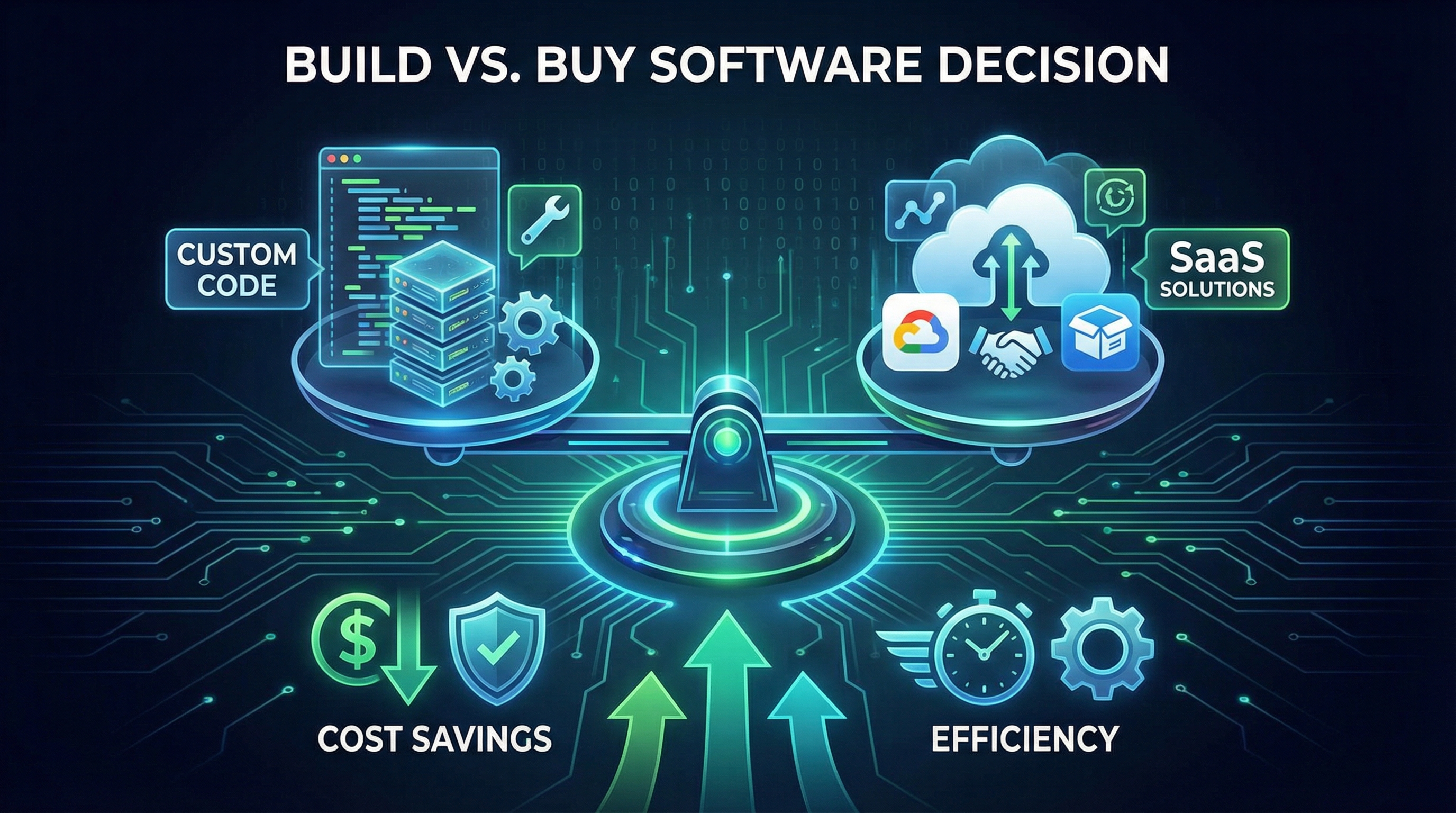
Cutting Software Costs: The Build vs Buy Decision in 2026
The build vs buy decision has never been more relevant—or more nuanced. AI has dramatically reduced the cost of building custom software, while SaaS prices continue to rise. The calculus that once clearly favored buying is shifting.
The Changing Economics
SaaS Costs Are Rising
- Average SaaS prices increased 12% in 2025
- Per-seat models scale linearly with headcount
- Enterprise tiers often 3-5x more expensive than entry tiers
- Vendor lock-in makes switching costly
Building Has Gotten Easier
- AI coding assistants accelerate development 2-3x
- Open-source components are more mature than ever
- Cloud infrastructure is commoditized
- No-code/low-code tools enable non-developers
A Framework for Deciding
Factor 1: Strategic Importance
Build when the capability is core to your competitive advantage.
Buy when it's commodity infrastructure everyone needs.
Example: A logistics company should probably build custom route optimization but buy HR software.
Factor 2: Differentiation Requirements
Build when you need unique functionality competitors don't have.
Buy when standard features meet your needs.
Example: If you need custom approval workflows that no SaaS supports, building may be necessary.
Factor 3: Total Cost of Ownership
Calculate true 5-year TCO for both options:
Buy TCO:
- Subscription costs (including growth)
- Integration and customization
- Training and change management
- Switching costs if you later leave
Build TCO:
- Initial development
- Hosting and infrastructure
- Ongoing maintenance
- Developer time for enhancements
Factor 4: Time to Value
Buy when you need to move quickly and the SaaS works out of the box.
Build when you can afford the development time and it provides lasting advantage.
Factor 5: Maintenance Capacity
Buy when you don't have (or want) ongoing technical staff.
Build when you have engineering capacity and technical leadership.
The Middle Ground: Customized Open Source
Between pure "build" and pure "buy" lies a powerful option: deploying and customizing open-source software.
Benefits:
- Lower starting point than building from scratch
- Full control and customization ability
- No per-seat licensing costs
- Community maintenance and improvements
This option works particularly well when:
- Good open-source alternatives exist
- You need significant customization
- Long-term cost reduction is important
- You have technical capacity to maintain
Real ROI Calculations
Example 1: E-Signature (Replace SaaS)
SaaS Cost (DocuSign):
- 50 users × $40/month = $24,000/year
- 5-year: $120,000+
Build/Deploy Open Source:
- Implementation: $15,000
- Hosting: $2,400/year
- 5-year: $27,000
Savings: $93,000 (77%)
Example 2: CRM (Keep SaaS)
SaaS Cost (HubSpot):
- $800/month = $9,600/year
- 5-year: $48,000
Build Custom:
- Development: $150,000+
- Maintenance: $30,000/year
- 5-year: $300,000+
Decision: Keep SaaS
The framework matters more than any single calculation.
Implementation Strategy
If you decide to build or deploy open source:
- Start with a pilot: Prove value before full commitment
- Document requirements thoroughly: Know exactly what you need
- Plan for migration: Data and workflow transition
- Build internal expertise: Or partner with specialists
- Establish maintenance processes: Updates, security, enhancements
How Syntas Helps
Our SaaS Conversion practice provides:
- Assessment: Identify which tools to replace
- Solution design: Recommend build, buy, or open source
- Implementation: Deploy and customize solutions
- Migration: Move data and users safely
- Support: Ongoing maintenance and enhancements
We've helped organizations reduce software costs by 40-70% while often improving capability.
Ready to evaluate your software stack? Contact us for an assessment.