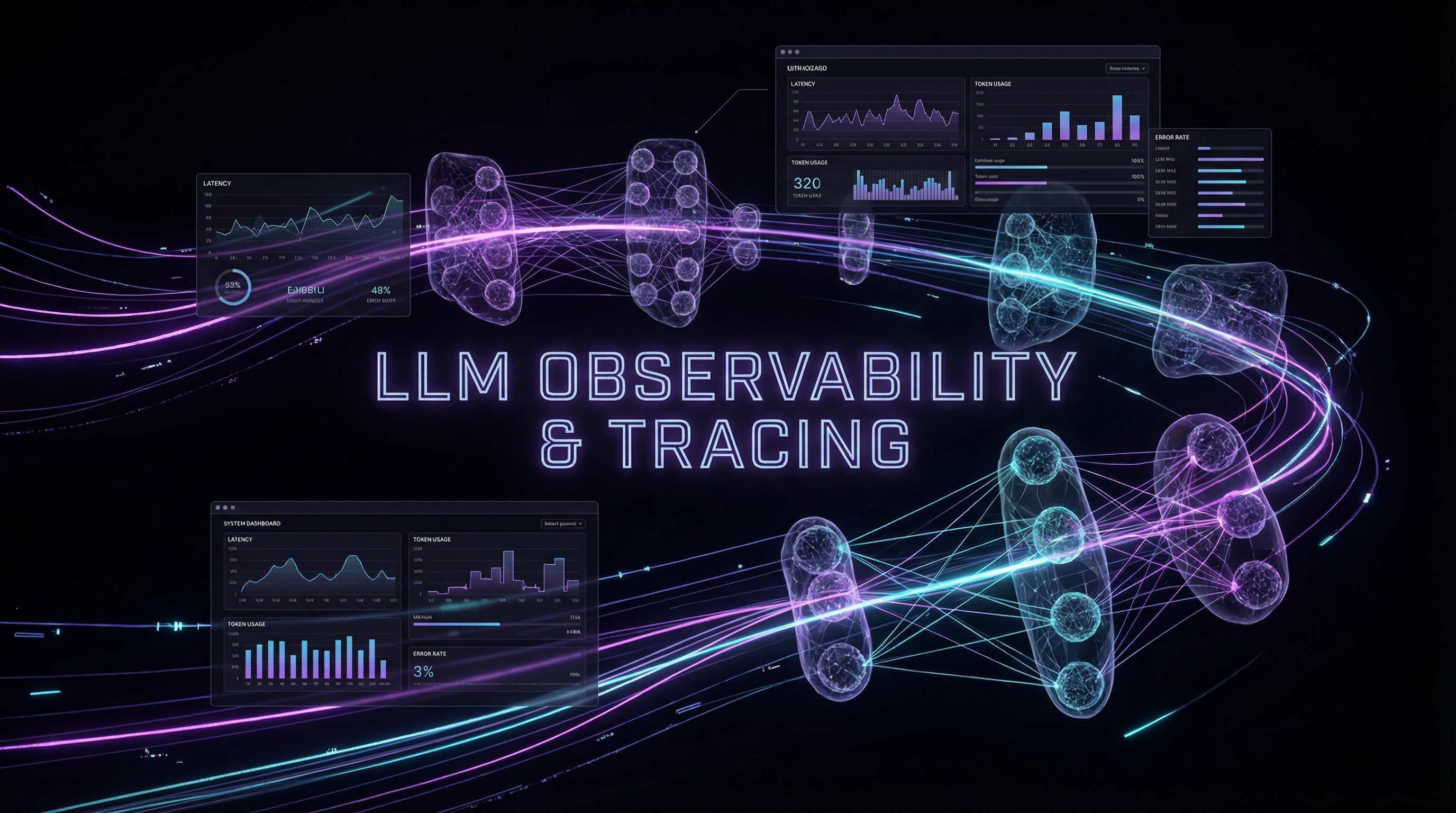
LLM Observability: Why Traces Matter for Production AI
Deploying a large language model to production is just the beginning. The real challenge is operating it reliably, cost-effectively, and with continuous improvement. This is where observability becomes critical—and traces are the foundation.
The Observability Gap in AI
Traditional application monitoring doesn't capture what matters for LLM systems:
- Prompt effectiveness: Which prompts produce good results?
- Token economics: Where are you spending (and wasting) tokens?
- Quality metrics: How do you measure output quality at scale?
- Latency patterns: What's causing slow responses?
- Error analysis: Why do certain requests fail?
Without observability, you're flying blind—unable to debug issues, optimize costs, or improve quality.
What Are Traces?
In the context of LLM applications, a trace captures the complete journey of a request:
- Input: The original user request or trigger
- Prompt construction: How the prompt was assembled
- Model interaction: Which model, parameters, tokens used
- Response: The raw model output
- Post-processing: Any transformations applied
- Final output: What was returned to the user
Each trace provides a complete picture of what happened, enabling debugging, analysis, and optimization.
Why Langfuse?
We recommend Langfuse as the leading open-source LLM observability platform. Key capabilities include:
Comprehensive Tracing
- Capture full request lifecycle
- Track nested chains and agents
- Link related requests together
- Store prompt/response pairs
Analytics and Insights
- Token usage by prompt version
- Latency percentiles and trends
- Error rates and patterns
- Cost allocation and forecasting
Evaluation and Testing
- Score outputs against criteria
- A/B test prompt versions
- Track quality metrics over time
- Enable human review workflows
Developer Experience
- SDKs for Python, JavaScript, and more
- OpenAI-compatible API wrapper
- Async and streaming support
- Self-hosted or cloud options
Implementation Best Practices
1. Instrument Everything
Don't selectively trace—capture all interactions. Storage is cheap; missing data when debugging is expensive.
2. Add Context
Enrich traces with business context:
- User/session identifiers
- Feature flags and versions
- Input classification
- Expected behavior indicators
3. Implement Scoring
Define quality metrics and track them:
- Automated scores (format compliance, keyword presence)
- LLM-as-judge evaluations
- Human feedback integration
- Business outcome correlation
4. Set Up Alerts
Monitor for:
- Latency spikes
- Error rate increases
- Token usage anomalies
- Quality score degradation
5. Enable Iteration
Use trace data to:
- Identify underperforming prompts
- Find optimization opportunities
- Validate changes before deployment
- Build regression test suites
Real-World Impact
Organizations implementing LLM observability typically see:
- 30-50% reduction in debugging time
- 15-25% improvement in token efficiency
- Faster iteration on prompt improvements
- Better reliability through proactive monitoring
- Clearer ROI through cost tracking
Getting Started
- Deploy Langfuse: Self-hosted or cloud
- Instrument your application: Add tracing SDK
- Define metrics: What does "good" look like?
- Build dashboards: Visualize key indicators
- Establish workflows: How will you act on insights?
The Syntas AI Lab
Our AI Lab practice specializes in LLM observability implementation. We help organizations:
- Select and deploy observability tools
- Instrument existing AI applications
- Define and implement quality metrics
- Build operational workflows
- Train teams on best practices
We're particularly experienced with Langfuse implementations and can have you collecting traces within days.
Ready to see what's happening in your AI systems? Contact us to discuss observability.